Am I going to die—like this
Black Water (Joyce Carol Oates Edition)Am I going to die?—like this? is the recurring question through which Kelly Kelleher confronts the Toyota’s plunge into black water. First it names her sudden disbelief; as the car sinks and she fights to get free, its repetition measures the narrowing distance between thought and death. The question does not resolve into certainty or rescue: it remains a fragile act of orientation inside a catastrophe she can scarcely comprehend.
The Question in the Crash
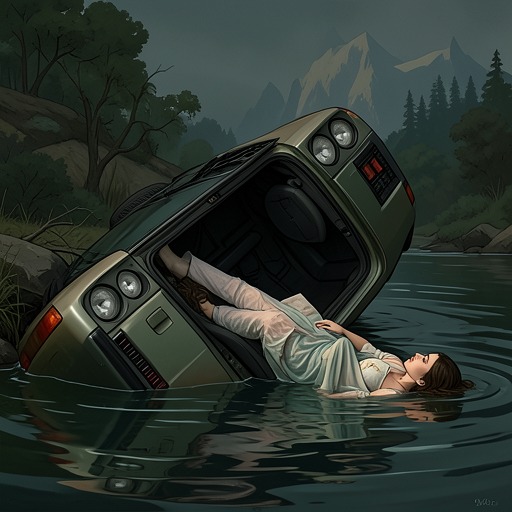
Before the accident, Kelly and The Senator have been talking companionably as he drives through the marshlands of Grayling Island. She is discreetly trying to steady his hand so the vodka-and-tonic in his plastic cup will not spill. The car is moving along Old Ferry Road, an unmaintained route no longer used after a paved road replaced it. Although The Senator has taken the wrong turn, he is headed toward Brockden's Landing; the mistake becomes lethal when the Toyota skids off the road and into Indian Creek.
The narrative gives the question its first force at the instant ordinary travel becomes mortal danger. The abrupt change is sharpened by what preceded it: talk, laughter, the moonlit road, and a journey that should have been manageable. When the car leaves the road, Kelly cannot make sense of how quickly events have turned. The question is not a considered meditation on mortality but an attempt to grasp the immediate, unthinkable fact that she may die in this particular car, in this particular darkness.
Repetition and Bodily Disorientation
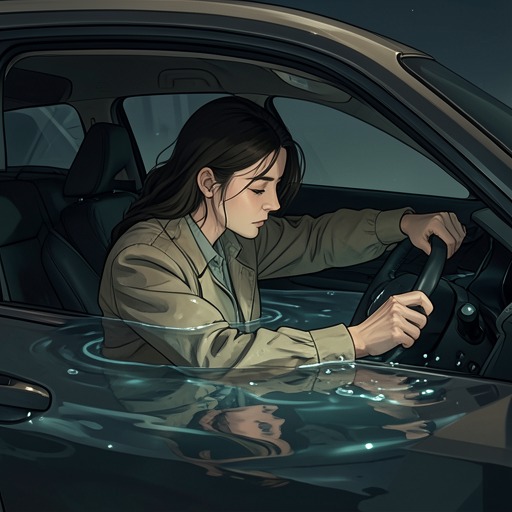
The question returns as the car sinks on its side and black water presses into the passenger compartment. Kelly and The Senator are stunned and struggling; he claws at his seat belt and forces his way through a door while she tries to escape. In the darkness, their bodies collide, the car’s position becomes difficult to understand, and Kelly cannot tell how much time has passed. The repeated thought gives the passage a refrain, but no stable perspective: each return occurs within the same worsening emergency.
The phrase’s variations reflect that instability. At one point the question appears with a changed pause and capitalization, but its substance remains the same: Kelly is trying to comprehend whether death is imminent while she is still alive and acting. She clutches at The Senator’s arm and leg as he shoves past her; his canvas shoe comes off in her hand, and she is left calling for help. The gap between the question and the physical scene around it is stark. Thought persists, but it cannot make the water stop, restore a way out, or make him stay.
Desire, Risk, and the Meaning of “Like This”
The question resonates with the events leading up to the crash, when Kelly has been drawn into a situation whose risks she has difficulty voicing. At the party, she cannot tell Buffy why she must leave: she is embarrassed, and she believes there will be no later opportunity if she does not do as The Senator asks. On the beach, his kisses stir a desire she experiences as the man’s rather than her own, followed by familiar anxiety and guilt about having made him want her and then refusing him. The crash abruptly transforms that earlier pressure into a struggle over her body’s immediate survival.
The phrase “like this” makes the fear concrete. Kelly is not asking about death in the abstract; she is trapped in a sinking car, unable to draw sufficient breath to scream, and facing a man who has managed to escape while she remains behind. Her attention turns to bodily possibilities and bargains: she is willing to trade one or both legs if rescuers will amputate them and let her live. That desperate readiness to accept injury sits beside her earlier joy in being alive, recalled in the memory of her morning jog along the beach, when she had wanted to live forever.
Refrain, Recognition, and Survival
As the black water rises, Kelly’s experience becomes difficult to distinguish from confusion and imagined sensation. She feels what seem like leeches on her face, then recognizes that it is only water; she is shivering in water that smells of sewage, gasoline, oil, and her own urine. Even so, she understands that The Senator’s violence in getting out came from blind panic, and she has faith. The narrative then restores his identity to her: she remembers that the man who has left her is The Senator.
The recurring question thus holds together two forms of recognition: the immediate recognition that her life is in danger, and the effort to keep making sense of her surroundings as perception and movement fail. Its repetition does not establish that Kelly knows her fate. Instead, it records consciousness persisting through shock, fear, and physical entrapment. The question’s force lies in that unresolved interval: Kelly has not stopped fighting, and death has not yet become a conclusion she can know.